Showing posts with label directions. Show all posts

Friday, September 27, 2013

Life is What Happens While You're Making Other Plans

I haven't posted here in a while. I'm in a bit of a transition period, and I'm not sure where it's going. My original intention was to take some time off and get my head together. Then, I would do some networking, send out some applications, and land another job.

So far, my head is a bit more together than it was when I started this whole thing. I am clearer on what it is that gives me a sense of purpose, what it is that gets me "in the flow". I am taking better care of my health, physical and mental. I am no longer a slave to the clock, and I'm not constantly drowning in a sea of stress. I have time to actually think.

I've been doing a lot of networking as well. Informational interviews, attending conferences and seminars, doing volunteer work, talking with friends. Reconnecting with colleagues in person and on social media.

I've been sending out a lot of job applications and resumes as well. I'm keeping my LinkedIn profile current, and I'm posting links on my website when my freelance pieces are published. But after nine months of actively looking, I haven't landed a job-type job.

Instead, I'm finding enough freelance and temp work to keep myself afloat. I have signed on with a temp agency, and almost immediately, they found me a month of almost-full-time work at a decent hourly rate. It  was the same type of work that I left behind -- not the sort of thing that I would want to go back to permanently, but interesting enough to revisit. Counting the commute, it took about 11 to 12 hours of my day, every day, five days a week, just like my old job. But my co-workers were nice, the money was good, and the work was tolerable.

My freelance work is a bit more satisfying -- I'm writing short articles about recent scientific publications, geared toward a scientific audience. I also just finished a magazine feature article for college undergraduates, summarizing the various ways you can discover what kind of a career really motivates you. (Pretty much what I've been putting into practice these last couple of years.)

In between all that, I've been keeping up with the long walks and time with friends and all the rest of it. I've had to drop the yoga classes for now because I've had some other expenses that I needed to take care of, but I look forward to getting back into the yoga as soon as I can.

Last week, I spent four days in Austin. Andrew De Leon released his first album, and a dozen of us
from his little Twitter community came to his release party. We came from California, Maine, Quebec, and everywhere in between. What a grand time that was. Even though most of us had never met in person, we were not strangers. It was like summer camp, making our plans for the day, hanging out, messaging each other -- what time should we meet for lunch? Whose turn is it to drive? This little band of Andrew-fans are my friends in the truest sense of the word.

We had a little pre-party party on Friday, when we stopped by the Moose Lodge just to see if we could find the place, and wound up meeting all of Andrew's family (they were setting up the party). Andrew's mom called him at home, and he hurried out to meet us. He is a total delight, as are his cousins Josh and Eric and his uncle Rey (his collaborators on the album), his parents, aunts, uncles, and all the others. To me, that was the highlight of the trip, since it allowed us to talk, and dance, and laugh on a more personal level. We also met Andrew's friends Jaime and Meigan, who feature prominently in his YouTube chats, the following night. The actual party on Saturday was a great celebration -- lights and music and excitement. It was Andrew's moment to shine.

I also reconnected with a classmate of mine from junior high and high school, whom I had only seen a few times since graduation. Fred is one of the best people I know, and it was such a joy to see him again. He had lunch with my friends and me, and my friends all think he's wonderful. He even stopped by the album release party for a little while, much to our delight.

So right now, the universe is taking care of me. I don't know where I'm going. Maybe this is my life now. I'm OK with that. I have good people in my life, and my bills are getting paid. There's no grand "Ta-da!" moment to mark the end of my sabbatical. Rather, it's a gentle blending of one stage into another. And that's OK.

Tuesday, April 2, 2013

My Elevator Speech

In the spirit of casting one's bread upon the waters... Here's my "elevator speech", what I'm looking for career-wise. I'm actively looking for work after my renewal year, and it always helps to let people know what you're looking for. Feel free to pass this along, even if you don't think you know anyone who could use this. You never know, after all.


Thursday, January 24, 2013

Can We Talk?


My year off is officially over. I'm still at home, but I'm actively looking for work. Maybe that will be a job in the conventional sense of the word, or maybe it will be a more creative way to bring in income. I'm not sure. I've tried telling myself that I ought to be checking the job ads more assertively, mailing brochures to potential clients, making cold calls and all. But it just doesn't feel right. I have chastised myself, telling myself to just get over my inertia and start the wheels moving again. Don't be such an introvert, I say. Which is kind of like telling myself to stop having such blue eyes or stop being so short.

I have found a much better source of motivation, though. It comes through in the morning when I am writing in my journal -- or sometimes at 3AM when I am wishing that I could get back to sleep. In the deep stillness of my room, little ideas make their way to the surface. Concrete, definite actions that I could take. Actions with energy and enthusiasm behind them. Actions based on what I do naturally, what I enjoy, what gives me satisfaction.

There's a stillness born of time away from the daily commute, the meetings and deadlines and periods of boredom interspersed with crises. In that space has come an appreciation of things that I have been doing for years, but have not integrated into the way I make my living. With that realization has come a desire to more fully integrate the marketable skills with the calling of what is most important to me.

I have come to acknowledge more fully my talent for talking about scientific and technical issues in language that is engaging and easy to understand. I might not get the story first, but I get it in context and I do my best to get it right. That's a real talent. It's much harder than summarizing one's research in the specialized language of one's own field. It goes beyond opening up a stream of data in the hopes that the more information you throw at people, the more likely they are to come around to your point of view. It's very different from "dumbing it down". Good science writing requires me to respect my reader's intelligence and convey an accurate, nuanced picture in language that is both precise and accessible.

Good science writing is an act of empathy. When I'm conducting interviews for an article, I have to do my homework ahead of time to know who it is I'm talking to and have some basic knowledge of their work. I don't want to waste this person's time asking basic questions that could be answered easily with a little online research. It's incumbent on me to know and convey to the person I'm interviewing the purpose of the article I'm writing and to ask for information that makes my article into something worth reading. I'm responsible for communicating to my source just why it is that he or she is exactly the person who can best help me learn and convey the specific information I'm going after.

I have to use my skills in asking questions to encourage my sources to talk about the most interesting, relevant, or important parts of their work. I have to listen carefully to what my sources are telling me. I can't assume that I know in advance what they are going to say. I can't shape their answers into what I think they should have said. I can't be reluctant to ask for clarification -- even if I think I understand what they meant to say. This requires a certain humility on my part -- a willingness to relinquish any concept of myself as an expert and to let my sources speak for themselves. My expertise comes in organizing and conveying the voices of all my sources as accurately and understandably as possible.

Empathy requires me to know something about the audience I'm writing for. What this audience is most interested in might not be the same thing that most interests my sources. Depending on the type of article I'm writing, I might have to spend some time educating my audience, but I can't be overly didactic without losing their attention. Everyone is busy these days, and a multitude of information sources compete for my reader's attention. I have to make it worth my reader's time to read my writing. I have to show my readers something new or present a different point of view on something familiar. Some part of what I say has to be relevant to the world they inhabit.

I have to be trustworthy. If I come across as selling a particular point of view or advocating for a particular cause, I might capture the attention of those who already agree with me. But I will lose those readers who disagree with me -- the very readers who might have an "aha!" moment or engage others in a constructive dialogue after having read my article. On the other hand, false balance is just as misleading as blind advocacy. On some issues (climate change is one notable example), the scientific consensus is so strong that giving equal weight to a small opposing minority is a distortion of the facts.

Trustworthiness also requires clarity. "Baffle them with bullshit" is not an acceptable approach here. Few intelligent readers come away convinced that because an issue is presented in dense technical prose, it must be important and correct. On the other hand, talking down to one's readers, using lazy metaphors, or affecting a false hipness only makes the writer look incompetent. The goal is to convey a message and convey it well.

Conveying a message also requires an understanding that we are not completely rational beings. Two reasonably sane, intelligent, well-intentioned people can look at the same set of facts and draw very different conclusions. We all operate within our own social, historical, and experiential frameworks, and we interpret what we see accordingly. A good writer must provide enough context and perspective to inform, but not overwhelm, her readers.

Our emotions affect how we react to information, whether or not we are aware of it. Thus, humor, diplomacy, and yes, empathy are far more than ways to "spice up" an article. They are necessary elements in connecting with one's audience and opening a space for dialogue -- or perhaps drawing the lines for battle.

The work I enjoy best draws on all these skills, but some of my previous jobs have required a "just-the-facts" approach. For some purposes, that's enough. An activity report for a government agency is not the right place to hone one's skills in humorous narrative nonfiction. But since I have all of these skills, it's up to me to find an outlet for them. Leave the cut-and-dried work to those who excel at it.

Lately, I've been exploring social media (FaceBook, Twitter, and the like) as a means of staying in touch with the people I've met through my travels, career, and various stages of my life. This has evolved into a means of conversing with people whom I have never met face-to-face, but with whom I share common interests and affinities. I'm exploring the nuances of brief written communications and asking myself how well it is possible to know another person through electronic interaction alone. Electronic communities are changing the way we understand friendship and the way information (or misinformation) spreads.

Increasingly, interest groups, businesses, and other organizations use these channels to shape what we think and how we talk to each other in ways that go far beyond the pop-up ads and "you might be interested in..." suggestions. Skilled communicators realize that this is where their audience is, and they seek out the people they want to reach in this way. Perhaps the entire message can be conveyed right there on the spot. Perhaps a brief note on Twitter alerts readers to a more detailed account elsewhere. Perhaps flinging an idea into the fray sparks a conversation or elicits a wealth of crowd-sourced information, an exchange of diverse points of view. In any case, it's a matter of going out and engaging in dialogue with readers where they are rather than passively waiting in the backwaters of the information stream.

If this is so interesting to me in my personal interactions, why not investigate ways to build this into my profession as a science writer? After all, one of the reasons I took 2012 as a year off was to discover ways of integrating the various values and interests I have into a means of supporting myself while contributing something worthwhile to the world.

Saturday, October 6, 2012

Blueprints and Data Mining and Jigsaw Puzzles


There are many ways to go about finding something when the way ahead is not entirely clear. Some of my friends take a goal-oriented approach. Assess where you are now, define where you want to be, then make a detailed outline of the steps you need to take to get from here to there. That's great when you have a clear idea of what "there" looks like.

Some problems can be solved by diving into books and articles and advice from friends. Find out what someone else already knows, and use that to make your design. That's great when the question you want to answer is something that someone else has already answered.

My problem is that I seldom know what my goal will look like. I may have a general dissatisfaction with the way things are and a vague sense of what direction I need to go, and that's about it. The life I imagined for myself 30 years ago bears little resemblance to the life I have today, and that's not such a bad thing. I didn't have the ability back then to imagine this life. I discovered it as I went along.

I did the best I could with what I had, and every now and then I took stock of things and saw where the pieces fit together and suggested the outlines of a next step or two. It's been like solving a puzzle.

First, you clear out an empty space where you can work. It's much harder putting a jigsaw puzzle together on a cluttered table. The pieces don't fit because of all the stuff underneath. You can't see what fits where because there are too many things in the way.

When you begin, you don't have a clue where most of the pieces are supposed to go. You might not even have a picture to help you along. So you start with what you have. Edges and corners, pieces that are clearly part of a bright pattern, like a flower or a jewel. You fit those together, and the spaces between them suggest other pieces that might fit in. The colors along the edges suggest interior pieces that might fit that general area. You try pieces out, and sometimes they fit and sometimes they don't.

You take a break when you need to, then you come back and fit a few more pieces into place. Pieces that you wouldn't have known how to place before you put those first pieces in. Sometimes, you realize that the pieces aren't fitting properly, and you have to undo a section before you plow on ahead.

Little by little, the picture emerges. Maybe it's what you expected, maybe not. Sometimes, pieces get lost and you wind up with blank spots in your puzzle. As long as the picture is relatively clear, it's enough.

I cleared things out in a big way over the past couple of years. I cleaned closets and weeded out files and got furniture that harmonized and fit my space. I quit a job that was taking up too much space in my life. I made time for quiet, reading, long walks -- and blogging!

I have begun to fit a few pieces into this clear space:
Yoga and walking, for a quiet mind and a healthy body. I went from "plank pose is gonna kill me!" to "I can do this!" The balance poses need more work, but I'm getting better. A three-mile walk now seems very ordinary to me.

A new guitar and several new CDs,
for more music in my life. I feel self-conscious about playing my piano, especially with my touchy downstairs neighbors. My guitar is quieter -- and much more portable. I'm having to re-learn what little I knew about playing guitar from my few lessons in the 1970s, and I am in serious need of some finger callouses. That will come.

Movies, art exhibits, panel discussions, and other events for mental stimulation. Sometimes with friends, sometimes by myself. Sometimes, I come away with an idea for the next move in my career. Sometimes, I just come away feeling inspired and happy. Both are valuable to me.

Writing projects, because this is a big part of who I am. I have a fiction piece coming out online next month, and a nonfiction piece being published this month. (I'll put in some links when they go live.) I am getting small bits of inspiration for several stories in progress. And most mornings, I write Morning Pages (a la The Artist's Way), which vary from brain dumps to aimless meanderings to bloody brilliant.

Social media,
as a way of getting the word out there and reminding people I still exist. I'm learning my way around Twitter and news feeds and my very own website, and a professional FaceBook page. It's kind of disjointed right now, and I can spend way too much time just looking at other people's updates. Gradually, I'm getting a feel for how to skim the important stuff, avoid the negativity, and make a presence for myself. It's a skill, like anything else.

Little pieces of the puzzle, coming together. I'm still not sure what the picture is, but something is starting to emerge.

Wednesday, September 26, 2012

Signal to Noise Ratios


Back to the science metaphors today. I got to thinking about how radically I have emptied out my schedule this year, and how it's helping me pay attention to things too long ignored. Improving the signal-to-noise ratio, as it were.

Right after grad school, I spent three years as a postdoc at Los Alamos National Lab. I was studying the way that surfaces influence the structure of thin coatings, to see if you could set up a surface that could direct a thin film to form with the properties you wanted. In order to pick up any kind of a signal at all on my instruments, I had to start out with substrate materials that had a whole lot of surface area, just to have enough of the thin film to make a detectable signal.

I had to make sure that the substrate surface was as clean as humanly possible, to eliminate interference from contaminants -- including air. For every sample I made, I had to start by baking my substrate material at a high temperature, under vacuum. This required custom-built glass furnace tubes that had to be made in the lab's glass shop, by the resident glass-working experts. My fellow researchers showed me how to set up the furnace and vacuum pump setup, and they clued me in on putting a cold trap between the two parts, so that pump oil would not back-flow into the furnace tube. They also told me that the copper coil I needed for this could be found at a local auto supply store.

After I baked out my samples, I had to close off the glass tube and transfer it to one of those big glove boxes that you may have seen on TV shows where people are working in a lab. The man in charge of keeping the glove box maintained had very large hands, so the gloves were sized to fit him. I have very small hands, so I had to learn to manipulate tiny tweezers and allen wrenches using thick rubber gloves that were several sizes too big for me.

Coating the sample surface was an exercise in patience. Meter in a little gas, let it condense onto the surface, wait for things to settle down, meter in a little more, repeat. Do this until the gas pressure gauge shows that no more gas is condensing down onto the surface. This sometimes took hours. Once, I tried to put two layers down on a surface, and I stayed at it for 36 hours straight before I finally gave up.

After I collected data from my instrument, I used a computer program (written by another colleague) to tease out the tiny signal from the thin film from the much larger signal from my supporting surface. Another computer program would interpret the resulting pattern, but the specific material I was studying hadn't been studied much as a thin film, so I had to piece together what I could from existing information and make reasonable assumptions.

I did manage to put together a general picture of what the surfaces were doing to the thin films. It's been almost 25 years, and others have gone much farther than this than I could.

What I'm getting at is this. In order to see anything at all out of this year-long experience of mine, I had to set up a situation in which I had a lot of time just for me -- my supporting substrate surface. I had to clear out any interfering noise from this time -- residual stress from a long day at work and commuting, much of my extracurricular activity, anything that would take away from what I'm trying to find. After the initial clearing-out, I had to protect my time from re-contamination. Only then could I begin to let in the things that I want to pay attention to.

I'm getting a lot of advice and assistance from friends and colleagues, but ultimately, I'm having to put this thing together myself. And now that little hints of answers are starting to come in, I'm having to try and make sense of what I'm finding out. Looking at what other people have done is giving me a general direction, but ultimately, I'm having to take what I can find and make some reasonable assumptions about the rest.

Very slowly, a little pattern is starting to emerge from the background. Other people may do this more elegantly or simply, but this is my project, and I am having to put together an answer that applies to me. The learning how to do it, the actual process of doing it, and the friends and mentors I'm meeting along the way are just as important (if not more so) than whatever answers I may come up with.

Monday, June 11, 2012

The Difference This Time


I often compare this year in my life to the not-quite two years between February 1995 and December 1996. Both times, I have been essentially unemployed, with a few small freelance projects here and there. Both times, I have spent a lot of time at home by myself, sorting out the thoughts in my head, re-evaluating priorities, and asking myself "what's next?"

That's where the similarity ends, however. That earlier "sabbatical" was not by my choice -- I was caught up in a mass downsizing and stranded in a one-company town with few other employment opportunities. It had been less than two years since I was downsized out of my previous job, and I had only just started to rebuild my savings. I was living in a small town, and although I had a fair number of acquaintances, I hadn't really made any close friends.

I spent most of 1995-1996 living in fear of bankruptcy, homelessness, and becoming permanently unemployable. In November 1995, I sold my house for just enough profit to pay the real estate agent's commission, and I moved into a thin-walled apartment on the edge of town. I lived on beans and pasta, and I gained about 50 pounds. It was probably the lowest part of my life (before or since), and I never want to go through that again. In fact, one reason I put off taking my current year off for so long was my fear of repeating that experience.

Just as I was emptying out the last of my savings account, I got a job offer that included partial reimbursement for my relocation expenses. I put my moving expenses on my credit card (thankfully, I still had a card with a high credit limit), I took out a cash advance to pay my first and last month's rent and security deposit on an apartment, and I bought my first few weeks' groceries in the new place using my credit card (something I NEVER do). I lived on peanut butter and jelly sandwiches until I got my first paycheck. (Beans and pasta were out of the question until the moving van arrived with my pots and pans.) I spent the first year living very frugally while I paid off my credit card as fast as I possibly could.

This wasn't "jumping off a cliff and building my wings on the way down", it was being pushed off the cliff and being rescued just as my belly-feathers were brushing the ground below.

This time around, I left my job voluntarily. I had been living within my means for about 15 years, and well within my means for about 6 of those years, so I had enough saved up to cover my expenses very comfortably for just over a year, and I have emergency funds to take me beyond that if necessary. (Bye-bye, kitchen remodeling.) I have been living in the same town for 13 years, and I have a wide and varied network of friends and acquaintances. Washington DC is home to think tanks, professional associations, and of course, the federal government. Science writing jobs, although not abundant in today's economy, are more plentiful here than probably anywhere else in the US.

All of those things give me a sense of security about my future that I didn't have before. But it goes beyond that. My previous experience, although painful, taught me about the things I can do when I really need to. I have a faith that is not entirely based on objective evidence that things will turn out all right this time. I do get frustrated when I go through a few weeks without any sense of direction or inspiration, but then something always happens to get me going again.

I still don't know how all this is going to turn out. I do believe that it's going to be all right this time. This time, I'm not standing at end of the plank, but rather a launch pad.

Friday, April 27, 2012

Science!


Why can't I seem to find any answers? These days, I seem to have a lot of general preferences and vague directions in place, but nothing I could use to find an actual project or job to work on. Yesterday, it occurred to me that, during my previous career as a laboratory researcher, I went through a similar phase every time I started on a new project. I had a general question that I wanted to answer, but only the first inklings of what I was going to do to answer it.

I could see the first few steps ahead: do a literature search to see what had already been done, figure out the first bits of data that I needed to take and how to frame the experiments. Decide what data I could collect myself, and what I would need from other people. Collect the equipment and materials that I needed: buy, borrow, or build. Colleagues who were better at various things would stop by and offer advice -- where I could get that particular kind of copper tubing or silica aerogel, how to stop the vacuum pump oil from backstreaming into my sample holder, why my structure refinement refused to converge.

Run those first few experiments. Pause, evaluate the results, figure out what I knew that I didn't know before. Figure out what else I needed to know. Move forward.

As the results started to come in, I had to figure out a way to organize them and start a preliminary outline of a manuscript to send to a journal. Putting the results on a framework helped me see what parts were still missing and what parts made sense (or not). As the answer evolved, the questions would evolve as well. The challenge was to strike a balance between following the questions wherever they led and staying the course with my original direction of inquiry.

At some point, usually with a nudge from a colleague or mentor, I would write a paper for publication. There would always be more questions to answer, more fine-tuning on the results, but at some point I just had to put it out there for review. Refinements could come later, but if I didn't stake my claim, someone else would move in and I would lose my opportunity. (I found that out the hard way.)

I think that I must be in the literature search phase of my one-year exploration. I am reading books, going to seminars, taking notes, trying to frame my questions and collect the bits of answers that I already have. I am talking to potential collaborators and colleagues to see what they are doing. It's not simply a matter of running into the lab, sloshing a few things around, and yelling, "Eureka!" No, I'm going to have to do this like a science project.

Friday, April 20, 2012

Asking for Directions


I recently heard for the first time "Autobiography in Five Short Chapters” by Portia Nelson (who played Sister Berthe, the nun with car mechanic skills, in the movie The Sound of Music). This prose-poem (which I have copied below) really resonated with me, as I had always been taught that wisdom and maturity would help you out as you encountered similar situations over and over during the course of your life. Changing routes entirely was not mentioned -- you were supposed to deal with whatever came your way, not just up and change your route.

However, there have been times in my life when I felt as though I were speeding down a metaphorical freeway in the wrong direction. Either I had missed my exit or I had just gotten turned around entirely. The longer I went without changing direction, the farther I would be from where I intended to go. Going faster wasn't going to help, it would just get me to the wrong destination sooner. No, what I had to do was to exit the freeway as soon as possible, find a place to stop, and hope that I could either find a map or find someone who could give me some directions. At the very least, I could look around and see what direction the sun was coming from or maybe spot a familiar landmark. If it was a relatively familiar neighborhood, I could find a detour route that would put me back on track. Otherwise, I would have to get back onto the metaphorical freeway and go back the way I came until I could locate where it was that I had intended to go.

Julia Cameron, in her book The Artist's Way, notes that just when you have decided to make a bold change in your life, The Test seems to come. In my case, I had decided to leave my job and support myself on my savings for a year. I had even decided when I would turn in my notice and tell my co-workers. Right about that time, I received a promotion and a raise at work. I was grateful for the hard-earned recognition, but I sensed that staying in that job at the new level would be like flooring the accelerator pedal and heading full speed in the wrong direction.

So here I am, checking my map and getting helpful advice (or not) from friends and strangers. Little by little, I am getting a sense of my surroundings. I am taking it on faith that if I take it slowly and check my directions often enough, I will find myself back on track. Walking on a sidewalk with no holes (or at least different holes).

"Autobiography in Five Short Chapters” by Portia Nelson
I
I walk down the street. There is a deep hole in the sidewalk. I fall in. I am lost ... I am helpless. It isn't my fault. It takes me forever to find a way out.

II
I walk down the same street. There is a deep hole in the sidewalk. I pretend I don't see it. I fall in again. I can't believe I am in the same place. But it isn't my fault. It still takes a long time to get out.

III
I walk down the same street. There is a deep hole in the sidewalk. I see it is there. I still fall in ... it's a habit. My eyes are open. I know where I am. It is my fault. I get out immediately.

IV
I walk down the same street. There is a deep hole in the sidewalk. I walk around it.

V
I walk down another street.

Monday, April 9, 2012

"Everything Else" Provides an Outline


One way of discerning the shape of an object is to fill in the space where the object isn't. I generally try to "stay positive" in my thinking, but I'm going to provide some outlines by listing some ideas that no longer work for me:

Your life's work is your job. Your career and a large part of your identity are defined by where you work, who you work for, and what you do for income. Your job is a prepackaged set of duties, defined by your employers on their terms. You are expected to help them advance their enterprise. The effect this has on you is of no consequence.

Work is hell. Part of being an adult is resigning yourself to work you don't enjoy because it brings in the money you need to buy the stuff you think you are supposed to have. It's not supposed to be fun, that's why they call it work. Just be glad you have a job.

Pie in the sky by and by. If you make enough money (after you finish paying for all your stuff), one day, you will be able to retire. Hope like hell that you are still healthy enough and rich enough to work in a few of the enjoyable, fulfilling things that you never found time for when you were working.

School is meant to prepare you for work. The reason you go to college is to put you onto a career path that brings in lots of money, so you can buy lots of stuff and eventually retire. All those humanities electives and extracurricular activities are a waste of time, unless they help you meet important people who will help you make a good start to your career. You don't have to enjoy your studies or like the career you are studying for, just as long as it makes you rich.

Busier is better. Life is just one big contest to see who can put in the most hours on the job and who can cram the most tasks into their day. The people who hold staff meetings by cell phone while driving way over the speed limit from company headquarters to the branch location are the ones who get promoted.

You have to be a team player. As in, "take one for the team", not "your team is there to back you up". Show up for all the company social events, wear the polo shirts with the company logo, skip your kid's baseball game for the all-hands meeting, make sure that you speak to the CEO every chance you get so that he remembers who you are.

Getting kicked off the team is a fate worse than death. The company provides you with your identity. If you think that the company is about to downsize, you must redouble your efforts, work longer hours, multitask better, and score as much face time as possible with anyone holding the rank of vice president or higher. If you are laid off, no one will ever hire you again. You will go bankrupt, your family and friends will leave you, and the rest of your life will be miserable.

Never hire anyone over 30. New college hires are inexpensive, plentiful, healthy, energetic, and accustomed to pulling all-nighters. Hiring people right out of college cuts down on your employee development costs, since you're letting the kids' parents pay the tuition for all the latest and greatest technical training. Once this training becomes outdated, hire some new kids. Corollary: If your hair is turning gray, you must dye it so that no one will ever know how old you really are.

As I said, those are some of the ideas I'm throwing onto the scrap heap. My hope is that once they are cleared out of the way, the picture of what I do want can emerge into sharper focus.

Tuesday, March 20, 2012

What's Next? Inklings


Following up on yesterday's post: the "big yes" tends to come after I do my homework. What do I want? What don't I want? What must I have, and what can I trade away for something I want more? Here is what I have so far (at least the bit I'm willing to share):
Must-haves:
1. Work that serves a meaningful purpose. Writing/editing reports that hardly anyone reads doesn't cut it for me any more. Cranking out proposals that generate business for the sake of enriching the guys at the top doesn't cut it either. Am I doing something that provides goods, services, knowledge, or understanding that makes peoples' lives better? Does my writing help someone look at an issue in a new way, explain a complicated concept in terms they can understand, organize a tangle of ideas onto a framework where you can see how things fit together? That's a must-have.

2. Work that pays the bills, with something left over for fun. Face it, big cities tend to be expensive places to live. But the energy, creativity, diversity, and opportunities of a big city feed me in ways that small towns somehow don't. Also, when I'm not earning enough money, I tend to think about money much more than when I'm earning enough. I have a very real sense of what "enough" entails for me, and it's not unrealistic. I've been at that level before, and I can get there again. (The American myth that more is always better is simply not true. There is such a thing as "enough".)

3. Work that engages my attention, curiosity, and imagination. I've had that kind of work before, and I found myself working really hard and putting in long hours, but not minding it. There's a whole different feeling after a long day doing something you love, compared with even a relatively short day doing something that drains your soul. Show me something new, let me research an interesting idea. Show me the story-behind-the-story. Let me tell the whole story, warts and all. Let me get you interested in something you hadn't paid attention to before.

4. Work that I can do for as long as my mind and my body will let me. The idea of enduring years of drudgery so that I can spend my declining years playing golf holds no appeal for me. I may slow the pace down as I age, but let my work be so fulfilling that I can do it the rest of my life and not regret it.

5. Work in pleasant surroundings, with pleasant people, and with the occasional change of scenery. No more gray cubicles, please. My little office corner at home has a window with a big oak tree outside. Mourning doves and squirrels come to visit. I can go wireless and sit out on the balcony, weather permitting. I have time for discussion groups, lunch with friends, and trips downtown (where something new is always happening).

As you can see, I'm not quite to the point where I type a few terms into an online search and find my bliss. I probably won't ever be at that point. However, I have a good idea of where to go looking and who to talk to to bring my picture into sharper focus. The outlines are a bit blurry now, but I can make out some general shapes.

Friday, February 24, 2012

Ground Training, Test Flights, and Flocks (or Not)


"The world is full of people who have stopped listening to themselves or have listened only to their neighbors to learn what they ought to do, how they ought to behave, and what the values are that they should be living for." -- Joseph Campbell

I have been calling this year of mindfulness a "sabbatical" or a "reboot break", but I'm not entirely satisfied with either of those terms. A sabbatical implies that my employer is giving me a leave of absence, after which I will return to my job, rested and refreshed, maybe having completed some preplanned project. A reboot break also implies a return to the same operating system, having flushed any unneeded bits of detritus out of my own personal cache. "Flying lessons" comes closer to it, implying an application of all I have learned up to now and an eventual launch into something (I'm not sure exactly what) for which I am well suited.

Like a bird learning to fly, I am doing something that many of my fellow creatures have done before. Watching other birds is helpful, but it's not going to get me off the ground. I have to actually flap my metaphorical wings and see what works for me and what doesn't. However, I can learn from the example of others -- my intentional and unintentional teachers.

Many of those teachers come to me by way of books. Karen Armstrong's books, A History of God in particular, have shown me just how much our concepts of what life is really all about are a mirror of our culture, our place in history, and our individual experiences. Knowing this has freed me to do my own refinements where the picture that has been handed down to me doesn't ring true. The Feminine Face of God by Sherry Ruth Anderson and Patricia Hopkins provides practical examples in the stories of several women who set out on their own search for what they hold most true. Julia Cameron's books (for example, The Artist's Way) provide even more specific "wing-strengthening" exercises, designed to break apart preconceived notions and bring forth what truly resonates for an individual.

I'm in the middle of reading Quiet: The Power of Introverts in a World That Can't Stop Speaking by Susan Cain. Reading Cain's descriptions of the Harvard Business School (with its extreme emphasis on extroversion), the constant chatter of open office plans, and groups that go with the loudest voice rather than the best idea has reinforced my hunch that my own discomfort with these environments is not a shortcoming, but rather an integral part of my inborn temperament. Reading her sketches of highly successful introverts feels like stumbling upon a meeting of the elders of my native tribe.

I was especially moved by Cain's biographical sketch of The Woz (Apple cofounder Steve Wozniak to the uninitiated). Wozniak was a shy, nerdy kid, following a passion for electronics that dated back to his early childhood. His father encouraged this passion, telling him that engineers can change the world. He sought out like-minded company, which led him to that fateful 1975 meeting of the Homebrew Computer Club. What Wozniak learned at these meetings inspired him to devote many, many before- and after-work hours on what would become the prototype of the Apple computer. Wozniak built on his experience as a young tinkerer and as a calculator designer for Hewlett Packard. He built his confidence with the help of his father, his fellow engineers in the Homebrew Computer Club, and later, with his colleague Steve Jobs. These connections gave him the support and inspiration he needed, but his actual thinking and work was done alone, away from the chatter of the group, and that was the key to his success.

Other members of my tribe offer me their wisdom directly, without the mediation of a book. My yoga instructors offer weekly themes and meditations, ingrained into me by the stretching and bending that follows. The Sunday platform talks at the Washington Ethical Society take my mind in new directions, aided by the comments and conversations that follow. Friends of mine who are more experienced in blazing their own trails provide proof that it can be done, as well as practical advice and encouragement. They also provide a reminder that I'm not really blazing a completely new trail for myself.

Instead, I am turning off of the six-lane interstate highway, switching off the GPS with its constant instructions on when and where to turn. The trail I am following is narrow and barely discernible through the weeds at times, but just when I think I'm hopelessly lost, I see a blaze mark on a tree or a familiar landmark to let me know that all is well. As you see by my metaphors, I'm still hopping along on the ground. You will have to take my word that I am starting to flap my wings and test the breezes. When I start talking about thermals and updrafts, cyclones and gusts and soaring, you'll know that I'm airborne.

Wednesday, February 8, 2012

Updrafts


In my previous post, I mentioned making a list of things that make me happy. One of my goals for this reboot break is to make these things a more integral part of my life. These are the things that lift me up, keep me going, and make me feel that I am being who I was meant to be. (Meant by whom? That's a whole other blog posting.) Here's the list so far, in no particular order:
beautiful surroundings
variety
discovery
being influential
making sense of things
having time to figure things out
deep conversations with good friends
traveling with pleasant companions
shared laughter
inspiring music
stories where the little guy wins
fairness
seeing an answer after a long struggle
truly being heard / truly hearing someone else
seeing things in a new way
absurd humor
living my beliefs, defined by me

Tuesday, January 24, 2012

Rum Tum Tugger and the Egyptian Cat


T.S. Eliot's disobliging cat, The Rum Tum Tugger, "only likes what he finds for himself." I can relate to that. If you don't want me to see a particular movie or read a particular book, just make it into a blockbuster hit. Line people up around the block, and I will go looking for something else. Tell me that it changed your whole life, and I might get around to investigating it in another ten to fifteen years. Fill my workplace with the popular kids from high school, all dressed in conservatively-colored suits, all chatting about cupcakes and groupons, who has the newest smart phone, and where do you get your beemer detailed, and I will polish up my resume and plot my escape.

On the other hand, if I stumble onto some quirky topic that few people have noticed, I will dive in and find out everything I can. I can take a tiny topic, put it into a bigger framework, and make a story out of it. My stories haven't achieved cult status yet, but people have mentioned to me now and then how some magazine article or web posting I wrote two or three years ago really got them thinking.

Having said that, the things that go beyond merely piquing my interest, the things that resonate deeply with me and stay in my mind for decades, tend to find me rather than the other way around. I may be looking one way for inspiration, and the "big buzz" comes at me from the other direction. Sometimes, I'm not looking for anything at all, and a big idea hits me like a wet mop in the face. If another human is involved, it's almost never intentional on their part. More likely, it's something they say or do that connects with something else in my mind and starts the electrical current flowing. It's something I see or something I read about that fascinates me and engages my imagination.

One such "big buzz" hit me on a trip to Paris a few years ago. My friend and I had parted company for the afternoon. She wanted to see the exhibits at the Musée d'Orsay, and I wanted to find an old Roman amphitheater that I had read about in my guide book (Arènes de Lutèce in the Latin Quarter). This was before handheld GPS devices were common, so I set off on foot with my paper map in hand. Every few blocks, I would check the map at the nearest bus shelter, looking for that comforting phrase, "vous êtes ici", to reassure myself that I was headed in the right direction. I almost missed the amphitheater, which is cleverly disguised as a public park and a playground in a residential neighborhood. I spent some time drinking in the ancient vibes and trying to imagine crowds of toga-clad spectators, but it wasn't the kind of place that would hold my interest very long. I had a few hours to myself before I needed to head back to the museum, so I started walking west, looking for anything that might be worth checking out.

I hadn't gone very far before I saw an imposing building with a large dome. The guide book said that this was Le Panthéon, and listed it as a place worth seeing if you had the time, but definitely not on a par with the Eiffel Tower or the Arc de Triomphe. Since I was there, I decided to stop in and see what this building was all about. I had not heard of this place before, and the admission fee seemed reasonable.

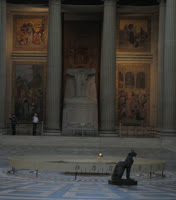
In the main hall, an Egyptian cat stood watch over Foucault's giant pendulum, which traced its endless track in a bed of sand. Murals on the wall told the stories of Ste. Geneviève, and Jeanne d'Arc. The real find, however, was down below, in the crypt. The names on the plaques were familiar from my college days: Voltaire, Rousseau, Hugo, Zola, Braille, Curie, Langevin, Dumas. More than plaques: the lower level was filled with tombs, marking the final resting place of the people who shaped French history, literature, and science. I wandered the passageways until closing time, filled with fascination and awe.

This place, which I had found so unexpectedly, moved me much more deeply than the Notre Dame cathedral, which I had heard so much about and was listed as a "must-see" in the guide book. I can't claim to have found Le Panthéon for myself, à la Rum Tum Tugger, but I claim the experience as uniquely mine, and it is all the more precious to me for that.

Saturday, January 14, 2012

Looking for Landmarks

I was told to expect a period of down time while my body and mind made the adjustment from the daily commute to keeping my own schedule. I just didn't realize how adrift I would be with most of the daily structure removed. I took a week and a half of vacation in late November, so I thought I had a head start on the relaxing bit. I was visiting my sister, and I had just wrapped up a very stressful couple of weeks at work, so I kept up a regular schedule of meals and sleeping, along with a schedule of activities. Not as jam-packed as my normal schedule, but an orderly flow nevertheless.

Now, my days are mostly free. Waking and sleeping hours are fairly arbitrary, although I do sleep at night and wake during the day. Meals tend to be a mid-morning breakfast, and mid-afternoon lunch, and a light snack at night. I have completed a couple of small items on my mammoth do-list, just to give myself a sense of accomplishment. I still have various appointments, the occasional lunch meeting. On those days, I have to be at a specific place, at a specific time. The structure doesn't seem to carry over into the rest of the week. That bothers me, a little. I have things to do, things to mull over, plans I made when I was setting this whole thing up. On the other hand, people who have been here before me say that the drifting doesn't last forever. Eventually, the days fall into a pattern and a sense of direction takes hold.

I remind myself that the major reason for being here, doing what I'm doing, is to break apart the old structures and make room for new ideas and opportunities. So for now, I will go with the flow (or lack of it).

Friday, January 6, 2012

Road Maps and Directions

Up until now, I have been somewhat intentionally nebulous in describing this grand adventure to acquaintances and co-workers, and I wonder if I come off sounding a little vague and new-agey. Dare I say "flighty"? I have used terms like "getting my head together", "decluttering my life", and "figuring out what my bliss is so I can follow it".

People who know me well have seen this transition coming for quite some time, and they are cheering me on (and wondering why it took me so long). They have seen what I can do when I have had free rein to indulge my creative self. They have seen how happy I am when I honor my creative side, but they also know the importance I attach to organization and planning.

Right now, my mind and my home are full of new projects I want to tackle, old projects that weren't worth finishing, and things that I promised myself that I would deal with "later". Middle age has left me with less energy at the end of the day than I used to have. A demanding job, coupled with a lengthy daily commute, left me too tired on weekday evenings to pursue my creative endeavors, and weekends were devoted to domestic chores and recovering from the stresses of the week. My "still, small voice" was having a tough time being heard through all the noise.

The organized side of me realized that things were not going to get any better until I could clear out some physical and mental space so that the still, small voice could make itself heard. I needed to "put away that which does not serve", as my yoga teacher puts it, in order to make room for "that which will serve". A few vacation days here and there would not suffice to do the job. It was becoming apparent that trying to shoehorn an endeavor of this size into my existing schedule was utterly hopeless. No, a big change was in order.

I have been pretty good about living well within my means, so I took stock of what I was spending each month and how much of this was discretionary. I have been saving money for my retirement, but also for things like a kitchen remodel and a new car. I discovered that I had enough saved up (not counting my retirement funds) to cover my expenses for a year. I read a book called "Reboot Your Life" that talked about a growing number of people who had taken six months to a year (or more) off of work to recover and chart their courses.

Once the organized side of me was satisfied that I could actually do this, and having a rough idea of how others had done it, the decision was actually very easy. Here, briefly, is the road map that I have laid out. Right now, it looks like one of those maps that show the entire U.S., with just the interstate highways charted out. Over time, I am hoping to focus in more and start filling in the details.

1) I am not retired. Unless I get hit by a bus sometime in the next 5 or so years (and I hope I don't!), I will very quickly outlive my savings if I try to retire right now. Frankly, I am hoping that I will never have to retire. I want to be like Andy Rooney and work at what I love until shortly before they haul me off feet first.

2) I am not on vacation. I sometimes refer to this as a sabbatical, even though my (former) employer is not funding me to do this. I have goals and a rough plan for this time. This means that I am not free to serve on 73 different committees, and I am not just sitting at home moping about.

3) I am not ready to hear anyone's advice on how to land a new job. One theme that comes through loud and clear in my reading and in listening to my friends is that taking sufficient time to clear my head is absolutely vital to making this thing succeed. I need to turn down the volume on all the input coming into my mind and sort through what is already there. I need to spend more time listening to my own voice and heeding my own counsel.

4) There will come a time, probably a couple of months from now, when I will move to the next stage of this process. This will be a time of discovery and exploration. My intention is to go out and explore my local environment -- the Washington DC Metro Area has plenty to offer. This exploration will come with no strings attached. Maybe it will help me plan the next phase of my career, or maybe it will just be a lot of fun. The best creative ideas come when they are not saddled with expectations of productivity. The emphasis during this stage is not what is "good for me" but rather what gives me joy.

5) I have been told, and I hope it's true, that this type of free-form exploration leads naturally to ideas that can be nurtured, developed, and brought to fruition in the form of concrete actions. The previous months will have been spent erasing my mental ruts and broadening my perspective. When I move into this phase, I'm going to be scheduling informational interviews, making career contacts, and exploring opportunities to start acting on my intentions -- and bring in a good income as well. Maybe I will create an entirely new niche for myself, or I may discover my niche in a place that I hadn't thought to look before. I have a pretty good idea of what I'm good at and what makes me happy. Putting that to work for me, making a good living at it, and making a positive difference in the world -- that's what I'm going for. It's less a destination than a sense that I am headed in the right direction.

In the meantime, I am sincerely grateful for the friends who ask if I want to join them for lunch or a movie. I am thrilled at the little spell of warm weather we are having, which allows me to go outdoors and saw boards for my next craft project or take a walk around the neighborhood. I love being able to read the entire newspaper and do the puzzles every day. And yes, darn it all, I'm going to tackle those two boxes of clippings. Tomorrow.